
The conclusion of a century-long quest 😲
Our VLT obtained firm evidence that Betelgeuse, a red supergiant star in the Orion constellation and one of the most famous stars in the night sky, is not alone!
1/4
📷 ESO/M. Montargès et al. Background: N. Rissinger (skysurvey.org)
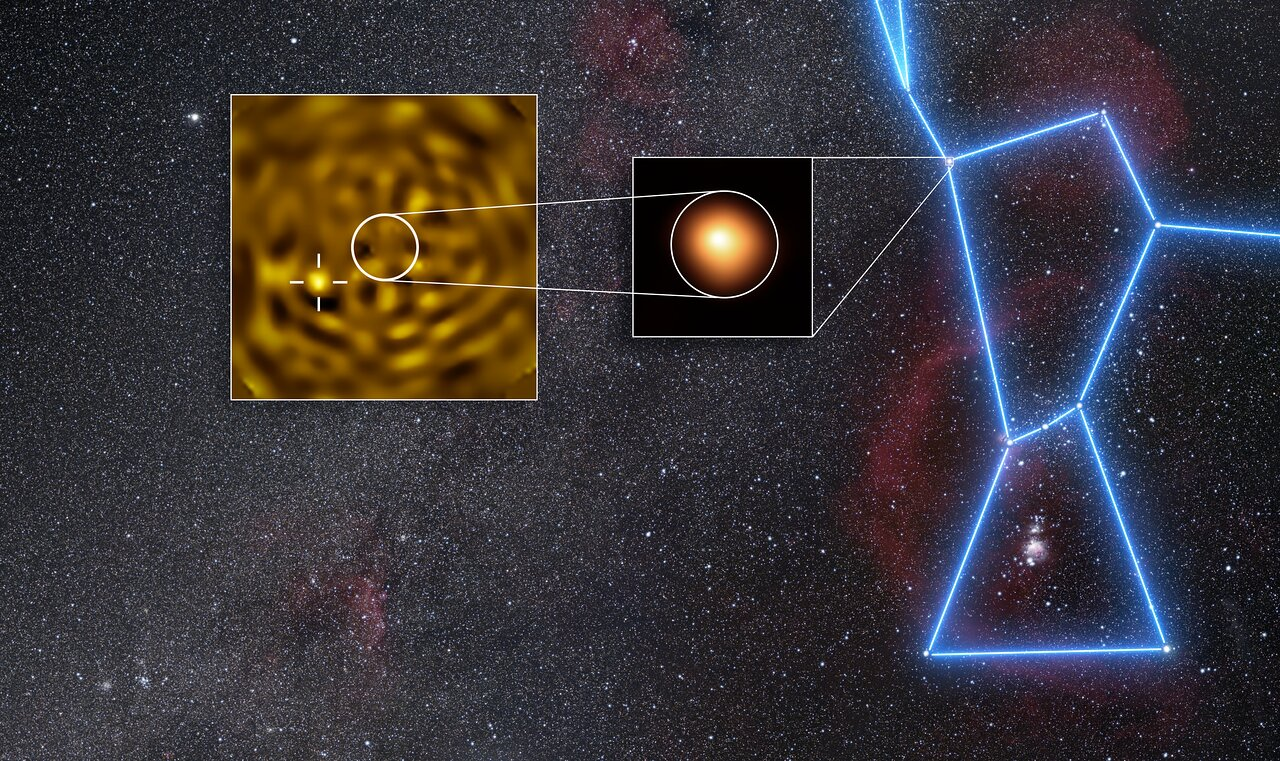
The brightness of Betelgeuse changes periodically. For decades astronomers had suspected that some of these variations could be due to a companion star orbiting around it.
Now, the VLT has captured the clearest image ever of Betelgeuse B, a faint star orbiting Betelgeuse.
2/4
📷 ESO/M. Montargès et al.
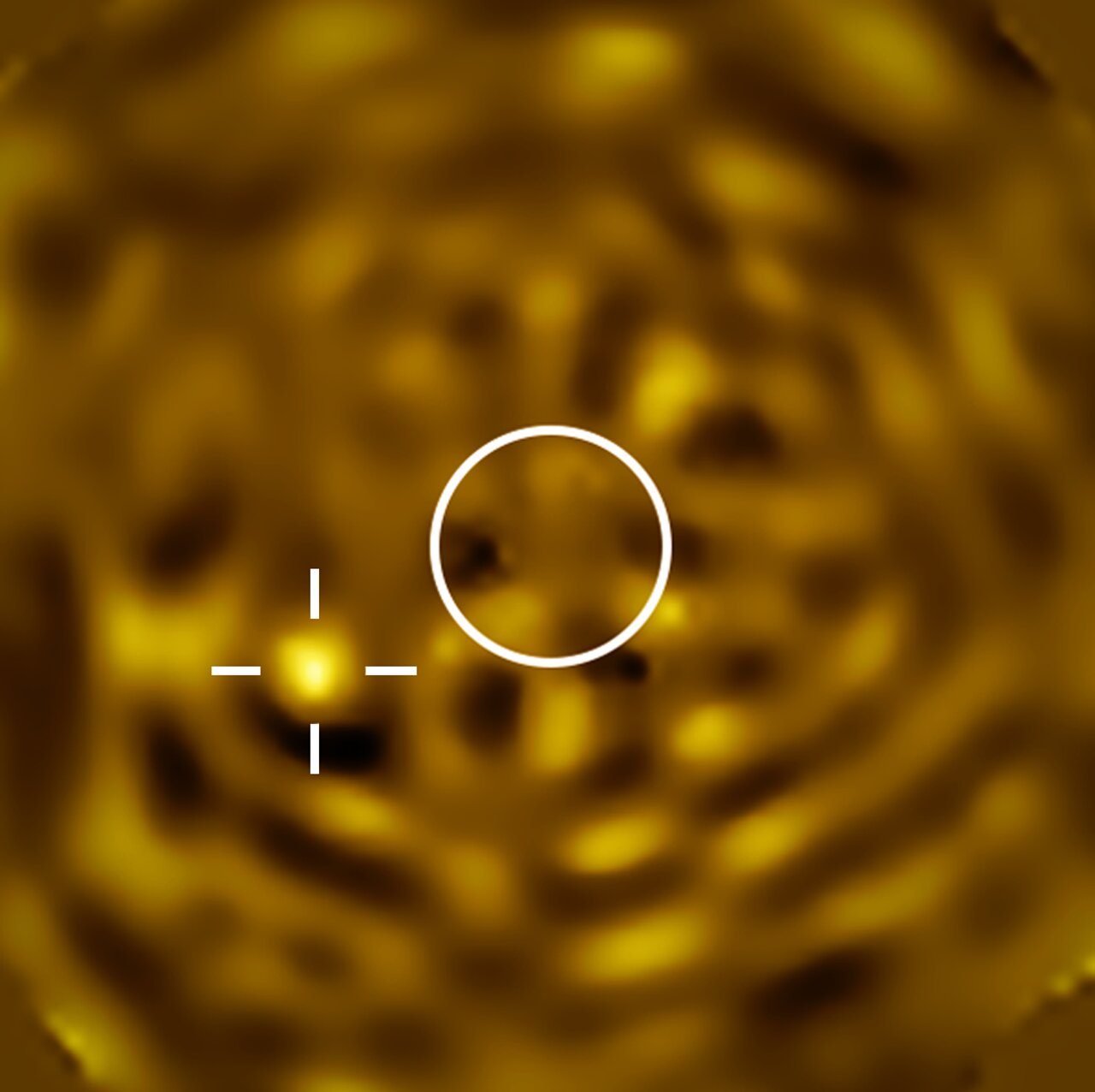
While there were indications for this companion's existence, including a possible direct detection with the Gemini North Telescope, this is the strongest evidence yet for Betelgeuse B.
The new observations also revealed that Betelgeuse B has two to three times the mass of the Sun.
3/4
📷 ESO/Digitized Sky Survey 2. Acknowledgment: Davide De Martin.
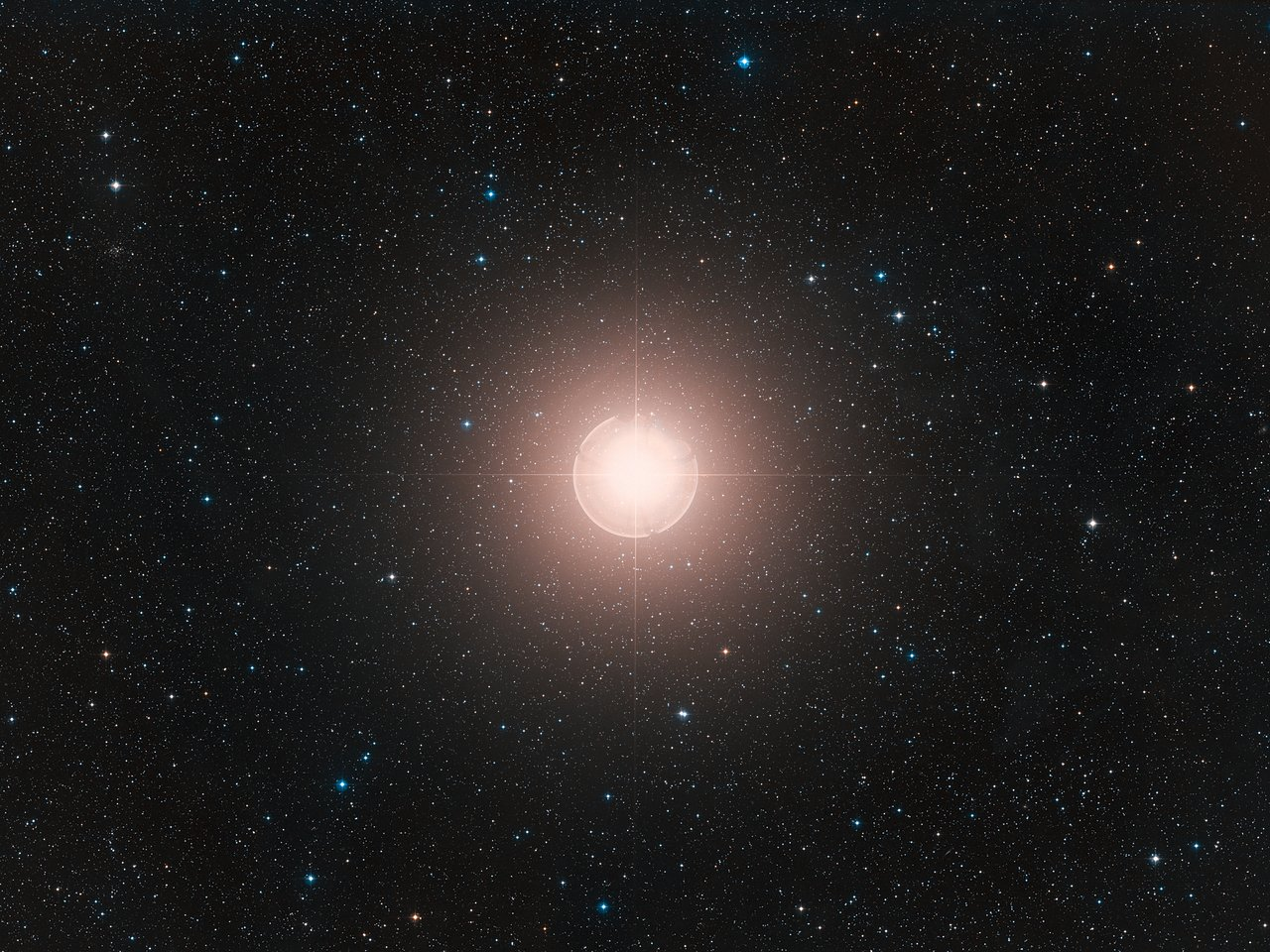
The potential detection of Betelgeuse B will prompt astronomers to investigate how the companion could affect Betelgeuse's anticipated supernova explosion.
Read more: https://www.eso.org/public/news/eso2611/
4/4

Seems pretty interesting, I'll read more about this as soon as possible :D
- replies
- 0
- announces
- 1
- likes
- 7

@esoastronomy
"The image in the middle inset in this image was taken in January 2019 with the SPHERE instrument at ESO’s VLT, and shows Betelgeuse itself.
The image in the inset on the left was taken in December 2024, when the companion was predicted to be furthest apart from Betelgeuse as seen from Earth. In this inset Betelgeuse has been removed, revealing a source (marked with a crosshair) consistent with being Betelgeuse B."
https://www.eso.org/public/images/eso2611a/

@AkaSci @esoastronomy Thanks, now I understand what the left insert shows. Is the image w/o removal of Betelgeuse available as well?
@rstub @AkaSci The removal was done during the analysis stage. Briefly speaking, the field of view rotates during the observations. This is something we would normally correct in other astronomical observations, but here it allows you to disentangle real features on the sky from internal aberrations. Even though Betelgeuse itself wasn't blocked by a coronographic mask, it is nevertheless removed during this process.

Saying that one of many gray splotches in the interference pattern is a dark star seems extraordinarily brave.
It may well be that there is such a body there, but that image does not prove it.
@zl2tod The position of the source coincides with an earlier tentative signal by another team. That signal was just at a 1.5 sigma level, namely, just 50% brighter than the noise. This new detection is 5-6 times brighter than the noise. So the question isn't so much whether it's a real source on the sky, but whether it orbits Betelgeuse. As we mention in the press release, the team plans to observe it at the other side of its orbit, but so far this agrees with what we expect the companion to be.